- Teacher: Prof. B. V. Patil
- Teacher: Dr. T. H. Jaware
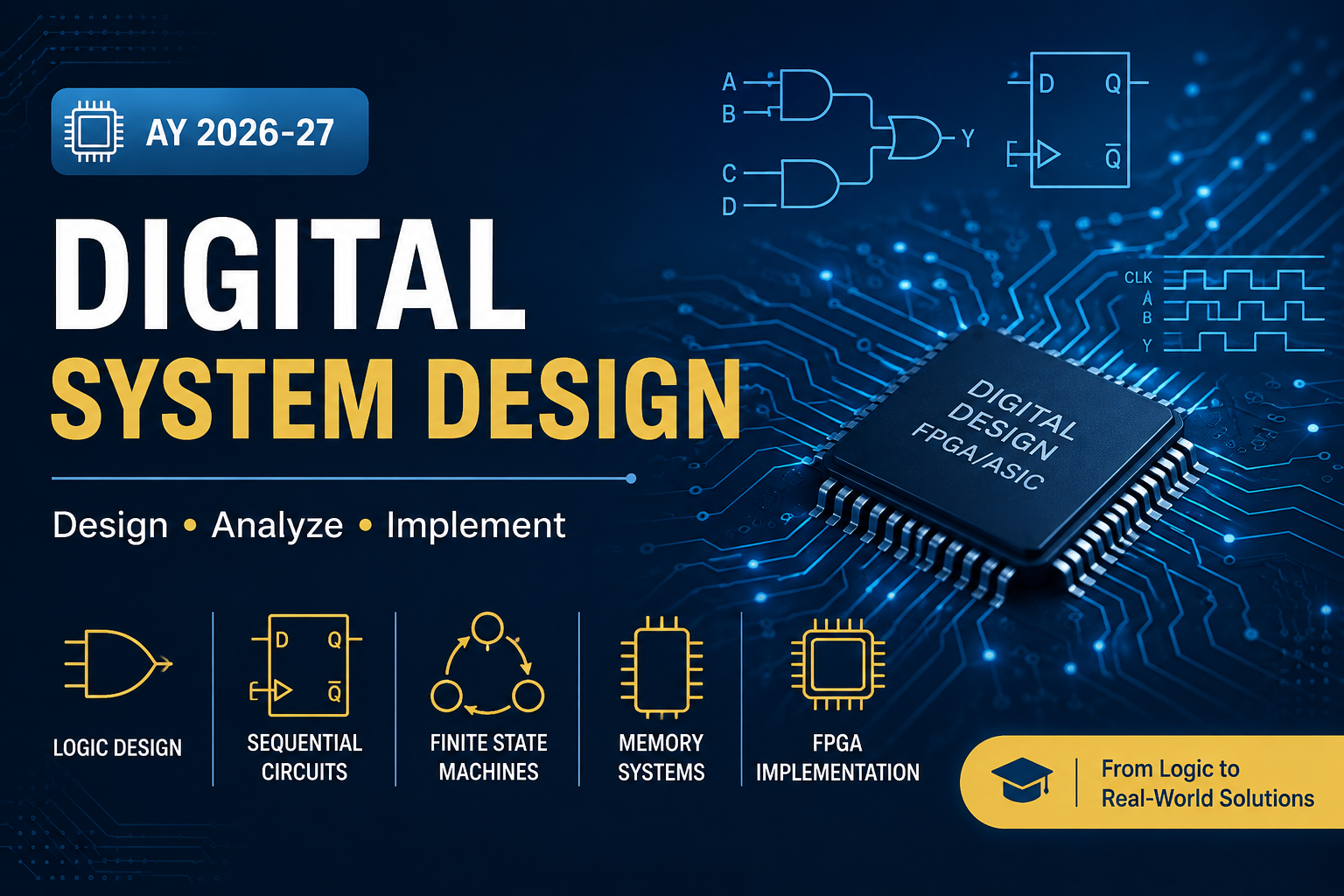
Welcome to the Digital System Design ((RCP23EPC203) course.
This course provides a comprehensive foundation in the analysis and design of digital electronic systems. Students will learn the principles of binary arithmetic, Boolean algebra, logic gates, combinational and sequential circuit design, memory technologies, and programmable logic devices. The course emphasizes logical thinking, circuit minimization techniques, and practical digital system implementation.
What You Will Learn
Perform binary arithmetic using signed numbers and complements.
Design and simplify Boolean expressions using Karnaugh Maps and Quine–McCluskey method.
Analyze and implement combinational circuits such as adders, subtractors, multiplexers, decoders, and code converters.
Design sequential circuits using flip-flops, shift registers, counters, and finite state machines.
Understand semiconductor memories and programmable logic devices used in modern digital systems.
Course Units
Unit I: Binary Arithmetic, Logic Gates, and Logic Families
Unit II: Standard Representation and Minimization of Logic Functions
Unit III: Combinational Logic and Arithmetic Circuit Design
Unit IV: Sequential Logic Design, Counters, Shift Registers, and State Machines
Unit V: Semiconductor Memories and Programmable Logic Devices
Learning Outcomes
After successfully completing this course, students will be able to:
Explain binary arithmetic and logic family characteristics.
Simplify Boolean functions using standard minimization techniques.
Design and analyze combinational logic circuits.
Design sequential logic circuits and finite state machines.
Compare memory technologies and implement logic using programmable devices.
Teaching–Learning Activities
Interactive lectures
Tutorial and problem-solving sessions
Circuit design exercises
Simulation-based demonstrations
Assignments and quizzes
Assessment
Student performance will be evaluated through:
Continuous Internal Assessment (CIA)
Assignments and Quizzes
Practical/Laboratory Work (where applicable)
End Semester Examination (ESE)
This Moodle course contains lecture notes, presentations, assignments, quizzes, announcements, reference materials, and additional learning resources to support your understanding throughout the semester.
Happy Learning!
- Teacher: Prof. N. L. Lokhande
- Teacher: Prof. A. B. Jayaswal
- Teacher: Dr. K. R. Thakare
- Teacher: Prof. Dr. Pramod Deore
- Teacher: Prof. Mrs. S. D. Patil